A podcast with my dad and I, a letter from me to our descendants, and a way to move $ & decision-making power to the movement for reparations.͏‌ ͏‌ ͏‌ ͏‌ ͏‌ ͏‌ ͏‌ ͏‌ ͏‌ ͏‌ ͏‌ ͏‌ ͏‌ ͏‌ ͏‌ ͏‌ ͏‌ ͏‌ ͏‌ ͏‌ ͏‌ ͏‌ ͏‌ ͏‌ ͏‌ ͏‌ ͏‌ ͏‌ ͏‌ ͏‌ ͏‌ ͏‌ ͏‌ ͏‌ ͏‌ ͏‌ ͏‌ ͏‌ ͏‌ ͏‌ ͏‌ ͏‌ ͏‌ ͏‌ ͏‌ ͏‌ ͏‌ ͏‌ ͏‌ ͏‌ ͏‌ ͏‌ ͏‌ ͏‌ ͏‌ ͏‌ ͏‌ ͏‌ ͏‌ ͏‌ ͏‌ ͏‌ ͏‌ ͏‌ ͏‌ ͏‌ ͏‌ ͏‌ ͏‌ ͏‌ ͏‌ ͏‌ ͏‌ ͏‌ ͏‌ ͏‌ ͏‌ ͏‌ ͏‌ ͏‌ ͏‌ ͏‌ ͏‌ ͏‌ ͏‌ ͏‌ ͏‌ ͏‌ ͏‌ ͏‌ ͏‌ ͏‌ ͏‌ ͏‌ ͏‌ ͏‌ ͏‌ ͏‌ ͏‌ ͏‌ 

moments: a newsletter on money + movements

by Morgan Curtis, Ancestors & Money Coach

“It’s the beginning of the story of our family no longer standing with the status quo around wealth hoarding. It’s the beginning of the story of our family saying “We want to be part of building a more just world.”

 Listen to the podcast 

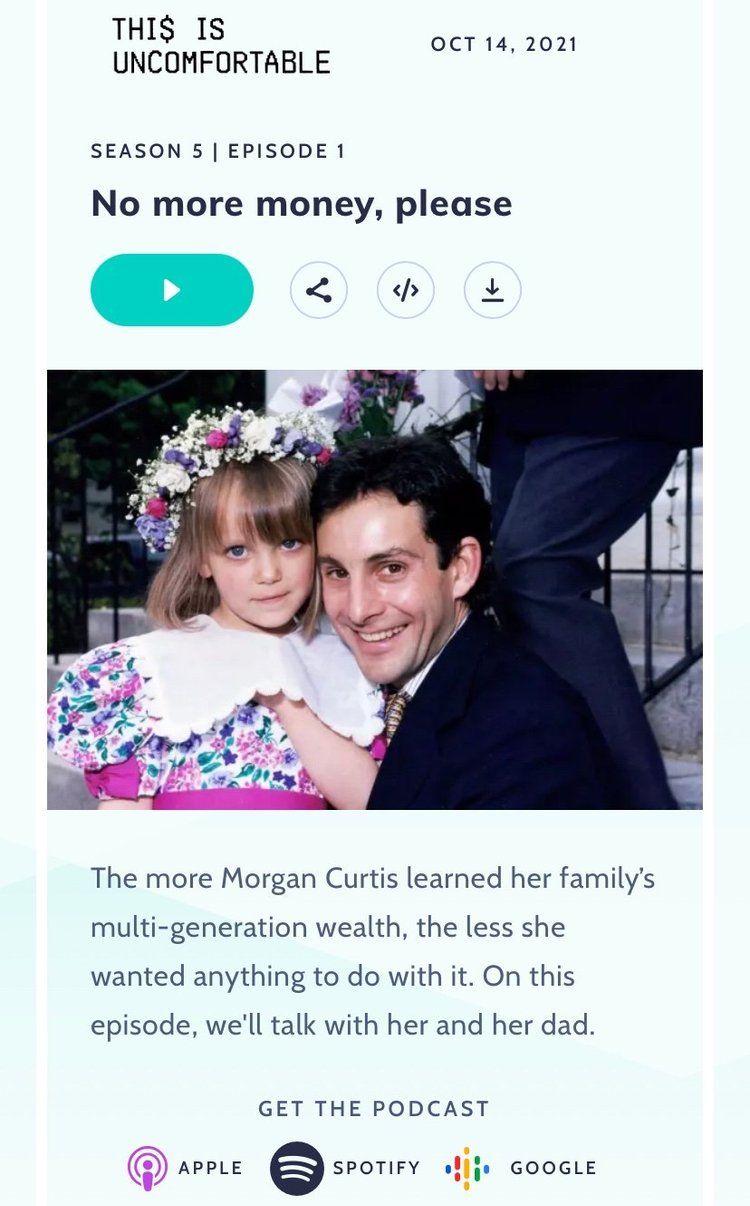
This is a quote from me from a three hour interview I did with my dad a few weeks ago for NPR Marketplace’s podcast This is Uncomfortable, which features "stories about the unanticipated ways money affects relationships, shapes identities and often defines what it means to be an adult."

My dad and I spent SO much time together when I was a child, and I think a lot of his qualities have rubbed off on me: determination, passion, dedication, fierce independence, taking risks, not giving up. However, our journey with wealth and my social justice values hasn’t always been an easy one. I knew it was a risk to try and bring a nuanced conversation about wealth redistribution to a mainstream financial media platform, but it felt important for such a show to include such a conversation. The result, whittled down to 43 minutes, is an intimate, vulnerable conversation between me and my dad about our family history, my childhood, and the choices I've made to redistribute my inherited wealth, and how that has impacted our relationship.

I know we already have too many stories with white, wealthy folks at the center, and at the same time I really hope that our talking about this in public helps normalize conversations about wealth redistribution amongst families like ours. I do feel sad about how a lot of the political analysis/theory of change got cut out in the editing (all of the conversations about grassroots movement building, redistributing decision making power, and funding organizing) in favor of a more personal story about us. I particularly dislike the title “No more money, please”, which has never been my request or message! It also errs on framing injustice as something that happened in the past, as if it isn’t structurally the same today.

All that said, I'd love to hear your thoughts and feedback if you take the time to listen in. I’m grateful for what I’ve already been hearing from listeners about the conversations it has been stirring across generations in their families.

A practice: Write a letter to your descendants

Speaking of intergenerational dialogue, what do you want the ones that come after you to know about the decisions you are making now? This is the question I sat with last year when I wrote Post-pandemic, post-revolution, a letter from future me to my (and my dad’s!) even-more-future descendants. My suggestion is to find a quiet place with pen and paper, write “Dear descendants,” at the top of the page, and let your thoughts flow freely for at least ten minutes. You can either write from the perspective of yourself now, in 2021, or a future version of yourself some years into the future, when you have taken significant steps towards wealth redistribution and reparative action.

“The money that came down through our family, gathered by generations of bankers, lawyers, captains of ships and industry, has finally been returned to the people and lands from which it was taken. It is my prayer that you are still connected to the Black and Indigenous villages into which it flowed, that you are shaped by their leadership and that you still find ways to mutually support one another as the world heats and unravels. These villages are refugia of knowledge and wisdom, places where intergenerational trauma was able to be witnessed and healed, where children grew into elders that guided their people onwards. These are your inheritance, your family’s legacy.”

Way to move money: #Case4Reparations Fund

I’m really excited to be redistributing wealth and decision making power by way of the Decolonizing Wealth Project’s new #Case4Reparations initiative, which provides “untethered resources to support organizing and advocacy to community-driven reparations efforts that will help build the case for local, regional, and national policy opportunities that will inform ways wealth (money and land) can be redistributed by institutions and/or governments to Black and Native American communities in the United States.” You can see the initial grantee cohort here, and make your own contribution to Liberated Capital here.

I had the chance recently to be on a team of white-identified facilitators supporting the Decolonizing Wealth Project's Heal With Us Summit for white philanthropic professionals. It was a really powerful day that centered ceremony, healing, and reparations. I was honored to be part of it.

A glimpse into what I’ve been reading for/during graduate school at Harvard Divinity

This is a mixture of “homework” and “pleasure”, with gratitude for where the lines are blurred. I decided to set America’s Racial Karma by Larry Ward as recommended reading for the upcoming Ancestors & Money Cohort, as I had my pen out circling on every other page while reading it, for so much was relevant to this work. Quoting psychotherapist Francis Weller, Ward says: ““There is some strange intimacy between grief and aliveness, some sacred exchange between what seems unbearable and what is most exquisitely alive.” The grief of racial trauma is such an opening, a gateway to healing America’s racial karma.” The work of Ancestors & Money is to keep nudging open this gateway.

Newsletter namesake poem by Mary Oliver

Volume 1, Issue 10

facebook twitter

Morgan Curtis, Ancestors & Money Coaching, Canticle Farm, Oakland, CA, USA

Powered by Squarespace

Unsubscribe